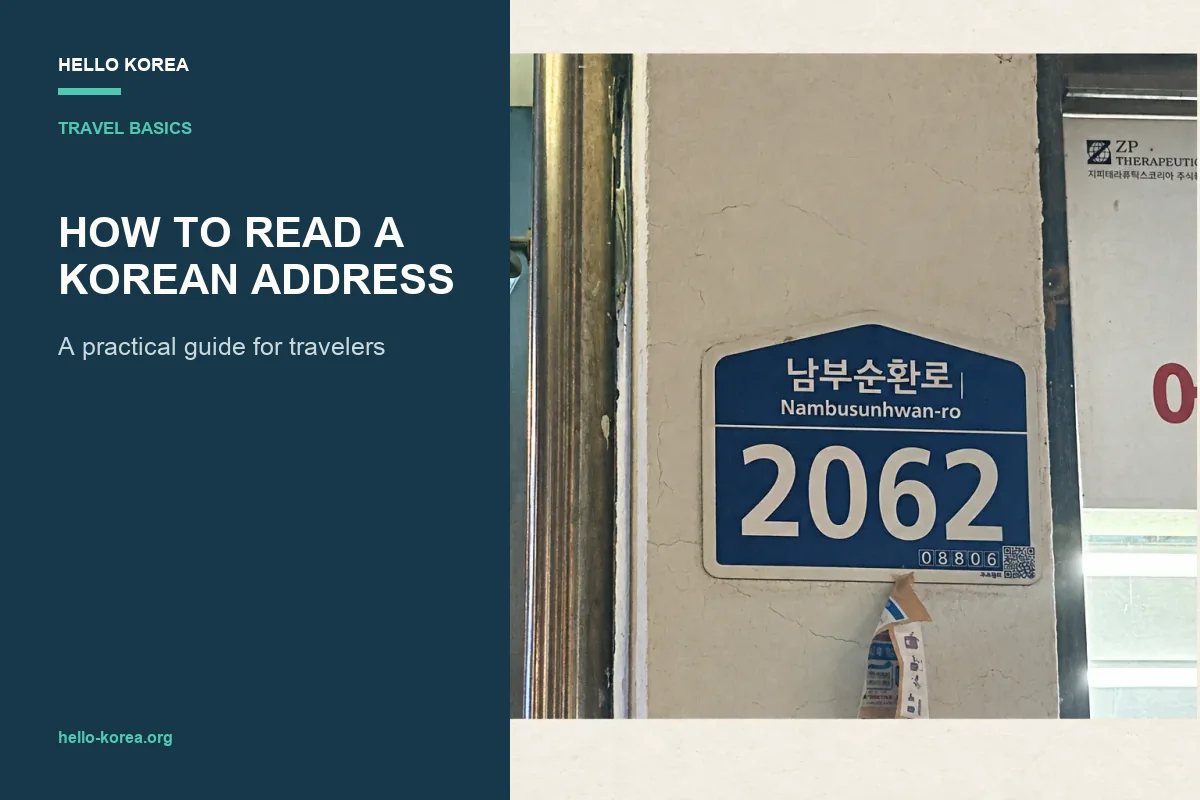
Quick answer: read a Korean road-name address as city, district, road and building number. In English, the building number usually comes first. Building numbers help you identify a position and side along the road, but use the map pin and entrance details to plan the actual walk.
This is the companion piece to our NAVER Map guide, which covers what to type into the app. This one covers what the address itself is telling you.
What a Korean Address Actually Looks Like
Here is one real address written three ways.
| Korean | 서울특별시 종로구 사직로 161 |
| Romanised | Seoul-teukbyeolsi Jongno-gu Sajik-ro 161 |
| English | 161 Sajik-ro, Jongno-gu, Seoul |
Notice that the English version runs backwards. Korean addresses go from largest to smallest — city, district, road, building. English addresses go from smallest to largest. Same address, reversed. This trips up almost everyone the first time they copy one into a booking form.
- 서울특별시 / Seoul — the city
- 종로구 / Jongno-gu — the district.
-gumeans district - 사직로 / Sajik-ro — the road
- 161 — the building number
The Building Number Helps You Find a Position
161 does not mean “the 161st building on Sajik-ro.” Building numbers are assigned from the road’s designated starting point, with odd numbers on the left and even numbers on the right.
For -daero and -ro, a quick estimate is the building number × about 10 metres from the road’s starting point. So 161 suggests roughly 1.61 km along the road’s numbering direction. This is an orientation clue, not a walking-route measurement. Smaller -gil roads may use shorter intervals depending on local conditions.
This follows current guidance from Korea’s official address service and Geumcheon-gu Office. Entrances, branches and pedestrian access can still change the route, so check walking directions before deciding whether to walk or take transport.
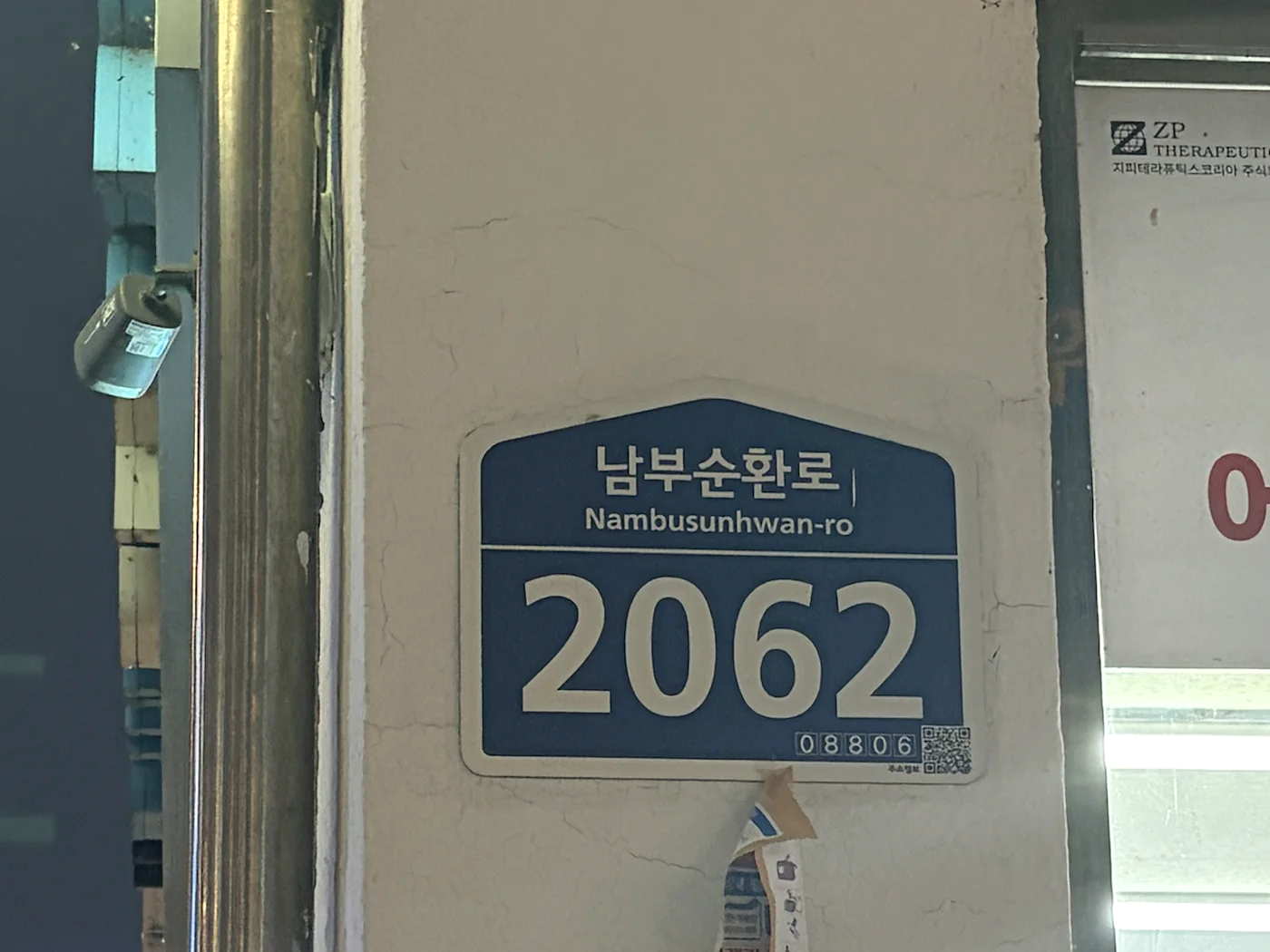
Odd on the left, even on the right
Facing from the road’s designated starting point toward its end, odd numbers are on the left and even numbers on the right. This is a direction along that road, not a reliable north/south rule for every street.
Check nearby building numbers and the road name together:
- Confirm you are on the correct road before comparing numbers.
- Use the odd/even side as a clue, then check the actual entrance and a safe crossing.
What this gives you on the street
- A large gap between your current building number and your destination can suggest a longer walk, but check the mapped route.
- For an odd-numbered destination, look for nearby odd numbers. Cross only at a safe, permitted crossing.
- If numbers are getting smaller while your destination has a higher number, check your direction and whether the road branches.
These signs can help you orient yourself even when your phone has no signal.
-daero, -ro and -gil: the Road Tells You Its Own Size
The suffix gives a broad clue to the road category. Korean local-government guidance describes -daero as major roads, -ro as smaller roads and -gil as other roads.
| Ending | General clue |
|---|---|
| -daero (대로) | Major road; the guide uses 8 or more lanes |
| -ro (로) | Road; the guide uses 2–7 lanes |
| -gil (길) | Other, generally smaller roads |
A -gil address may lead to a smaller street, but the suffix alone does not tell you whether a taxi can reach the entrance. Check the building pin, access restrictions and pickup or drop-off point.
The Older System: What “Seongsu-dong 12-4” Means
Sooner or later you will be handed an address that looks nothing like the one above — something like Seongsu-dong 12-4. That is the older jibun system, which numbered plots of land rather than positions along a road. Road-name addresses became the legal standard on 1 January 2014, but jibun never really left everyday speech.
- Seongsu-dong — the neighbourhood.
-dongmeans neighbourhood - 12 — the main lot number
- 4 — the sub-lot number
Occasionally you will see san (산) in front of the number, as in Gosan-dong san 1. That marks forested or mountain land. You are unlikely to need it, but it is not a typo.
How to tell the two apart at a glance
| If the address contains | It is |
|---|---|
| a -dong, -eup, -myeon or -ri followed by a number | a jibun (lot) address |
| a -ro, -daero or -gil followed by a number | a road-name address |
Do not use the hyphen as your test. It is tempting, because jibun addresses usually have one — but road-name addresses can carry a sub-number too, so Sajik-ro 161-1 is perfectly normal. The name before the number is the only reliable signal.
Which Format to Use Where
| Situation | Use |
|---|---|
| Searching in NAVER Map | Road name. Jibun often works too — see the NAVER Map guide for tested examples |
| Taking a taxi | Either. Show the driver your screen rather than reading it aloud |
| Hotel or booking forms | The official English road-name version |
| Deliveries and online orders | Road name |
For a taxi, show the full Korean address and the place name on your screen. Confirm the correct branch and entrance rather than relying on pronunciation alone.
What does not work is naming only the neighbourhood. “Seongsu-dong, please” will get you a question, not a ride, because a single -dong can cover a very large area with hundreds of destinations in it. Give the full address, or at minimum a specific landmark. If you are booking through an app instead, our Kakao T and k.ride guide covers how the destination gets entered for you.
Postal Codes
Korean postal codes have been five digits since 1 August 2015. If you find a six-digit one online, the page is out of date.
As a visitor you will almost never need one. It matters for posting things and for some checkout forms; it does nothing for navigation. If a form demands it, the official lookup below will give it to you.
Getting the Official English Version
When you need an address in English — a visa form, a delivery, a hotel booking — do not guess at the romanisation and do not use a random converter site. The Korean government runs one.
juso.go.kr is the official address service. Look up the Korean address for its English road-name rendering and five-digit postal code. Keep any building, floor or room details supplied by your accommodation, and follow the form’s own field instructions.
Common Mistakes
- Giving only the neighbourhood. A
-dongis far too big to be a destination. - Writing the English address in Korean order. English runs small to large: building, road, district, city.
- Treating the distance estimate as exact. It is a rule of thumb, and narrow
-gilstreets can be numbered more tightly. - Treating the hyphen as proof of an old-style address. Road-name addresses have sub-numbers too.
- Assuming the road suffix guarantees vehicle access. Check the actual entrance and drop-off point.
- Trusting a Google Maps address without checking. Coverage in Korea is limited — see why Google Maps falls short here.
Official Sources Used
- Korea’s official address service (Juso) — road-name numbering rules and official English address lookup
- Geumcheon-gu Office road-name address guide — road categories, odd/even sides and distance estimates
FAQ
How do I read a Korean address?
Read it as city, district, road and building number. The building number identifies a position along the road rather than the count of buildings. Use nearby numbers for orientation and the map for walking distance.
What does -ro mean in a Korean address?
It is a road-name suffix. Broadly, -daero denotes a major road and -gil a smaller road; the suffix does not guarantee vehicle access or a particular walking route.
What does the hyphen in a Korean address mean?
It separates a main number from a sub-number. Both lot addresses and road-name addresses can contain a hyphen, so look at the road or neighbourhood name to distinguish the systems.
Why do Korean addresses come in two versions?
Korea replaced its land-lot system with road names, which became the legal standard in January 2014. The old form survives in conversation and on older signage, so both are still in circulation.
How do I convert a Korean address to English?
Use the government service at juso.go.kr. It gives the official English spelling and the postal code.
Do I need the postal code as a tourist?
Almost never. It is for post and for some forms, and plays no part in getting you to a place.
How to Read a Korean Address: The Short Version
Read the city, district, road and building number together. Odd and even numbers help identify the side when facing from the road’s start toward its end. Keep the Korean address and exact map pin saved for checking the entrance.
For getting the address into an app that actually works in Korea, carry on to the NAVER Map guide. If you are wondering whether you need an account to use it, the short answer is no — the longer one is here.
Leave a Reply