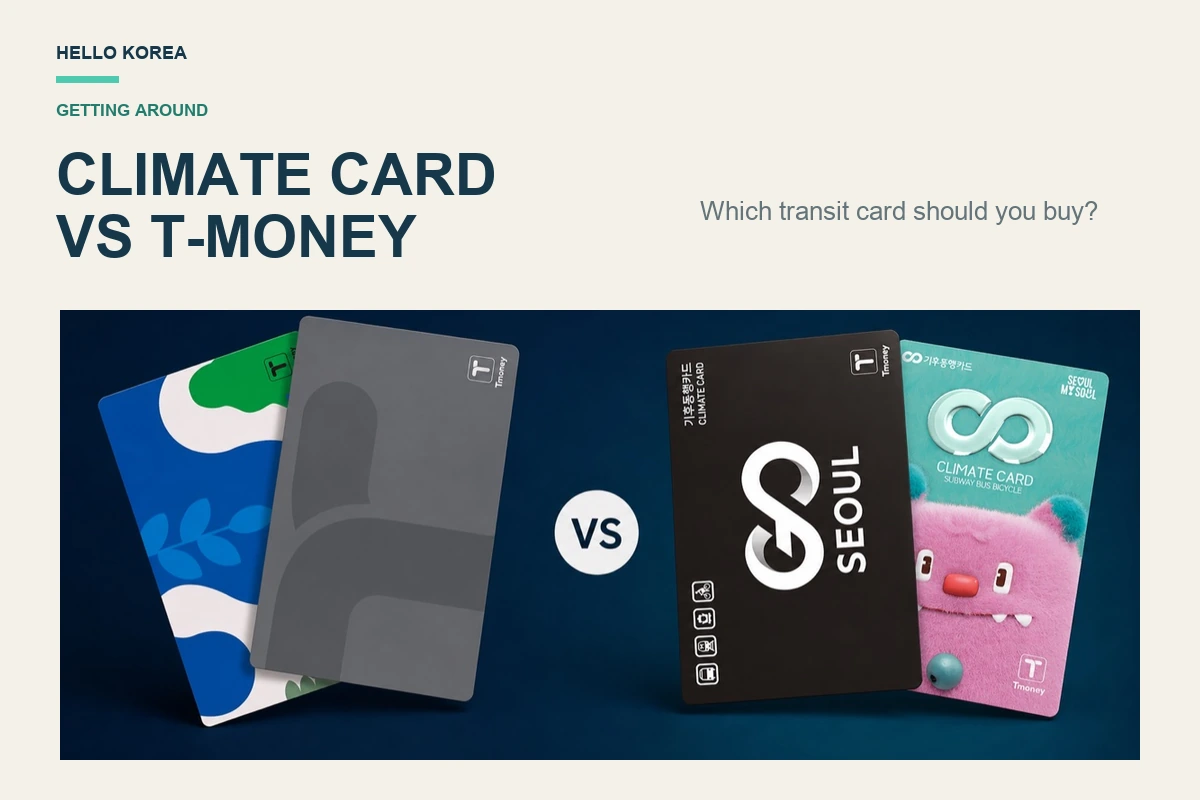
Climate Card vs T-money — Quick answer: Buy a T-money card if your trip includes anywhere beyond the Climate Card’s eligible Seoul network, an airport or intercity bus, taxis, shops, or simply an itinerary that may change. Choose a short-term Climate Card only for a packed, Seoul-based 1–7 day stay when you have checked that your regular subway and bus routes are covered. Do not buy both by default: add T-money as a backup only when you already know you need an excluded journey, a taxi, or another T-money use.
Do not start by calculating a magical number of rides. Start with your routes. An unlimited pass that fails on the one journey you need is not a bargain.
Screenshot note: The field photos in this guide were taken in August 2026. Product displays, payment choices, eligibility, and available options can vary by location and date. Check the current official information and the machine in front of you before paying.
Climate Card vs T-money: the Fast Decision
| Your trip looks like this | Start with | Why |
|---|---|---|
| One or two days in Seoul, a relaxed pace, or an itinerary still changing | T-money | It is pay-as-you-go and useful beyond one tightly defined transit network. |
| Three to seven busy sightseeing days, mostly ordinary Seoul subway and bus rides | Short-term Climate Card | A fixed-duration unlimited pass can be simpler when all your regular routes are eligible. |
| Seoul plus Busan, Jeju, Suwon, an intercity route, or an airport/intercity bus | T-money | The Climate Card is not a universal Korea transport pass. |
| You want to use taxis or pay at participating shops as well as ride transit | T-money | It can be used on public transport and at affiliated merchants showing the T-money logo. |
| You have several full Seoul sightseeing days and a known excluded route, taxi, or out-of-Seoul journey | Both | Use the Climate Card only for covered days and T-money for the known exception. |
When comparing Climate Card vs T-money, coverage should come before cost. But a price guide also helps. The estimates below use Seoul’s adult transit-card subway base fare of KRW 1,550. A bus-to-subway transfer is one integrated fare journey, not automatically two paid trips.
How many rides before a short-term pass costs less?
| Short-term pass | Pass + KRW 3,000 physical card | Break-even if buying a new KRW 3,000 T-money card too | Break-even if you already own T-money |
|---|---|---|---|
| 1 day: KRW 5,000 | KRW 8,000 | 4 base-fare journeys | 6 base-fare journeys |
| 2 days: KRW 8,000 | KRW 11,000 | 6 total | 8 total |
| 3 days: KRW 10,000 | KRW 13,000 | 7 total | 9 total |
| 5 days: KRW 15,000 | KRW 18,000 | 10 total | 12 total |
| 7 days: KRW 20,000 | KRW 23,000 | 13 total | 15 total |
This compares short-term pass + KRW 3,000 physical card with a KRW 3,000 T-money card + KRW 1,550 × paid base-fare journeys. Distance surcharges, transfers, youth fares, a KRW 3,000–5,000 T-money card price, and whether you already own a card change the result. Treat it as a decision aid, not a universal promise.
Short-term prices and what to check before you buy
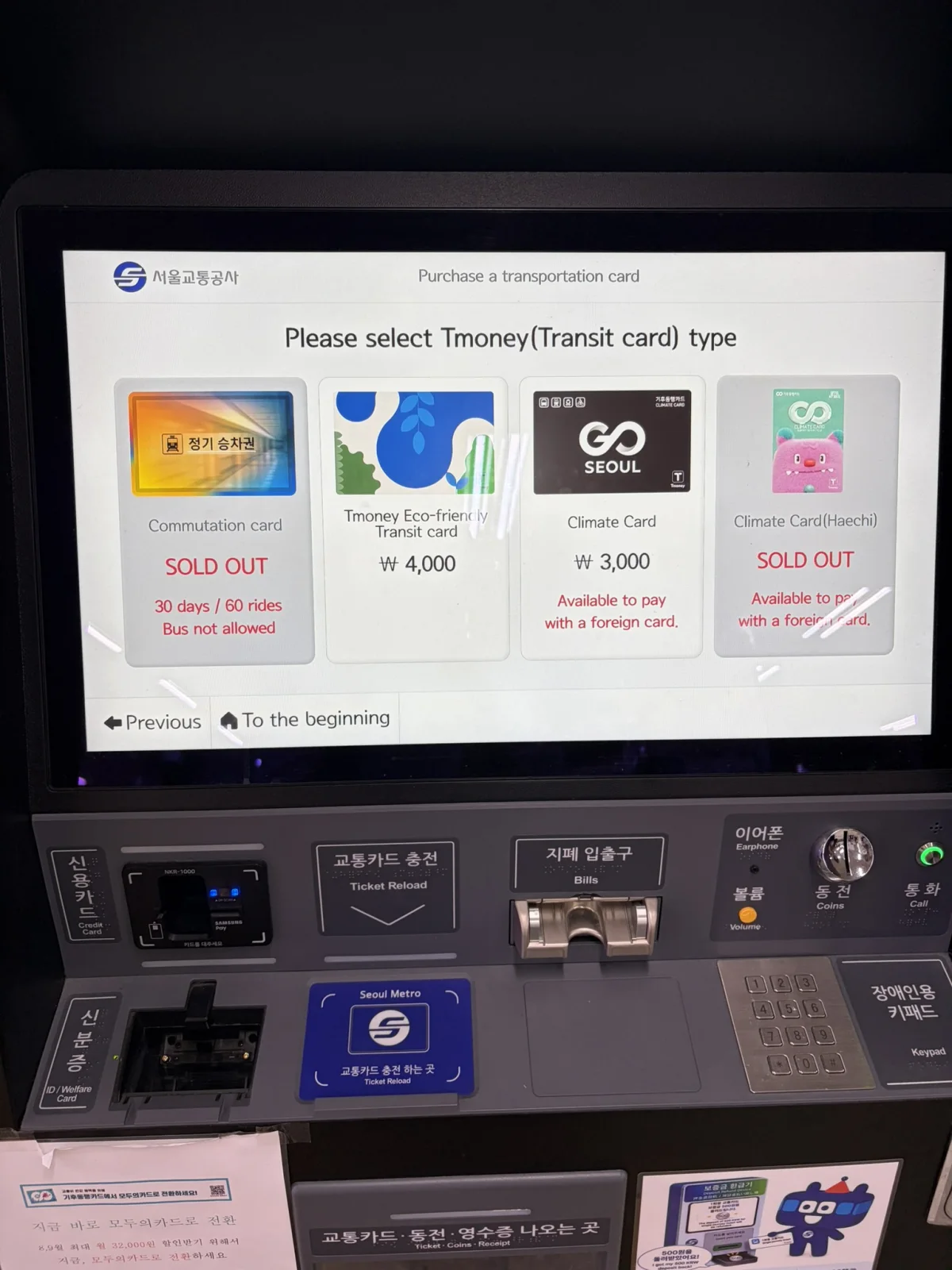
For visitors, the relevant question is simply: Do I want a 1-, 2-, 3-, 5-, or 7-day unlimited local-transit pass, and are my routes eligible? The official Seoul Climate Card page lists the short-term prices as KRW 5,000, 8,000, 10,000, 15,000, and 20,000 respectively. The physical card itself is a separate purchase; the official Korea Tourism Organization card guide lists it at KRW 3,000.

Check the product name, pass length, payment screen, and service range at the time you buy.
Choose a short-term Climate Card only after checking your routes
The short-term Climate Card can make a compact Seoul trip wonderfully easy. You load a duration once, tap for eligible rides, and do not need to keep calculating individual subway and bus fares all day. Whichever card you pick, the Seoul subway guide covers the part the card does not: finding your direction, changing lines and choosing the right exit.
It is a good fit when your hotel and sightseeing plan sit inside the Seoul local-transit pattern: museum, market, neighbourhood, café, then another subway or Seoul city bus. A busy day in places such as Hongdae, Myeongdong, Gyeongbokgung, Seongsu, Jamsil, Gangnam, or Yeouido can involve several rides, and a short-term pass removes repeated topping-up decisions.
But “Seoul trip” is not a coverage test. Seoul’s official guidance excludes the Sinbundang Line, subway travel outside the card’s service range, intercity and airport buses, and buses not licensed by Seoul. Its route list also contains boarding and alighting details that matter on edge-of-city journeys. For example, being able to board inside the range does not automatically mean you can exit wherever you want.
Before you buy, do this five-minute check:
- Put your hotel, first attraction, evening plan, and any day trip into NAVER Map.
- Note each subway line, bus, airport connection, and destination outside central Seoul.
- Compare the exact routes with Seoul’s current Climate Card service-range information.
- If one important route is excluded or you cannot confidently check it, do not make the pass your only way to travel.
That does not mean you have made the wrong choice if you hold a Climate Card. It means you should also have a T-money card or another fare plan before you reach the excluded journey.
How long should your short-term pass be?
Match the pass to the days you will actually be sightseeing in Seoul, not the total number of nights in Korea. A five-night trip that spends day one arriving, day three on a trip outside Seoul, and day five leaving early may not need a five-day pass. A three-day city break with morning-to-night exploration might.
The pass clock is the detail people miss. Seoul says short-term-pass validity begins on the day the card is charged; you cannot pre-load it for a later start. Buy it when you are ready to begin using it, and ask at the selling point if the displayed flow is unclear.
Why T-money is still the safer default

T-money is not an inferior version of the Climate Card. It solves a different problem: flexibility. You load a balance and use it as you travel rather than buying a fixed number of unlimited days.
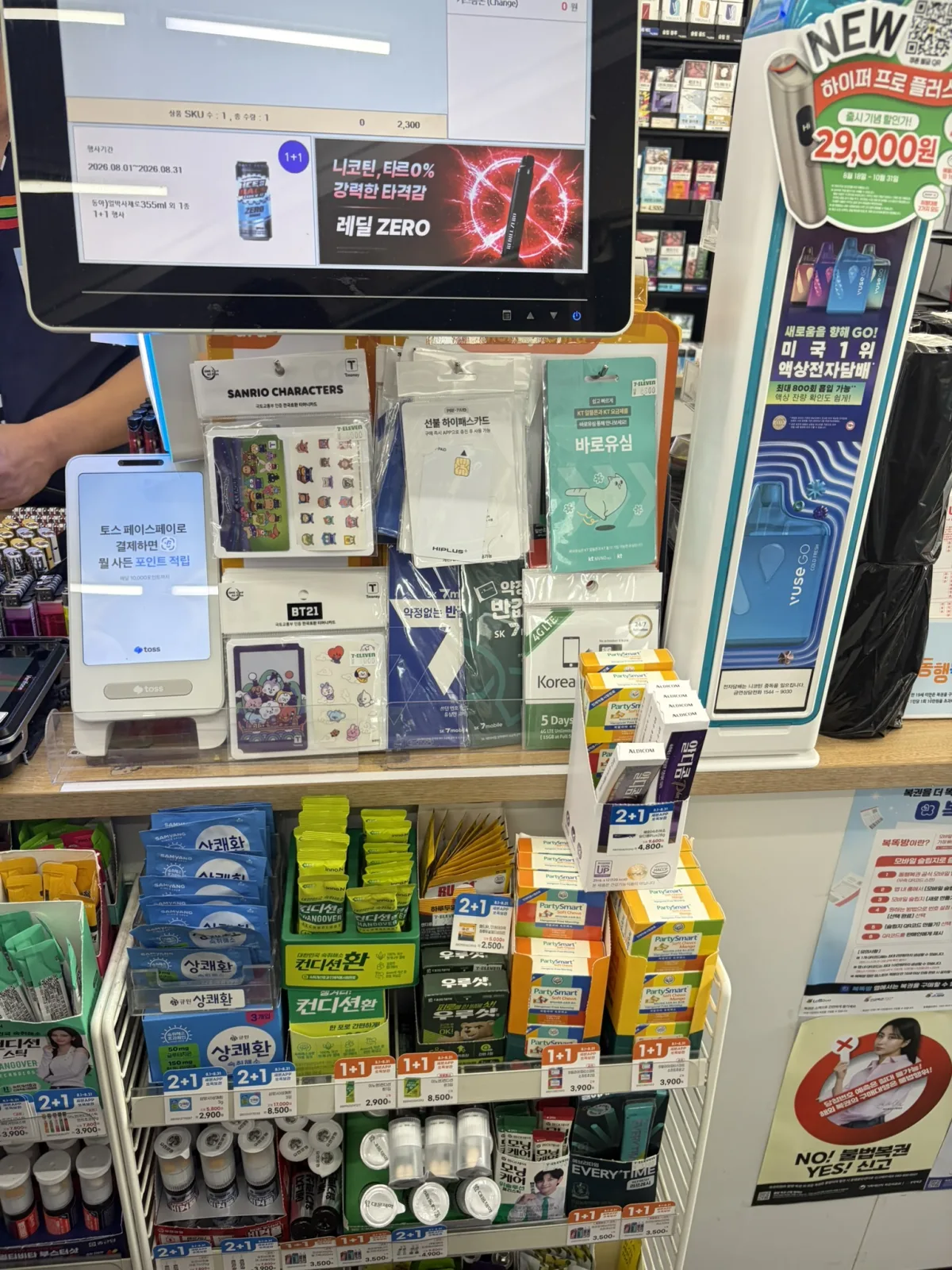
Korea Tourism Organization says T-money can be purchased and loaded at convenience stores nationwide and used for public transport and at affiliated merchants displaying the logo. That broad usefulness matters when a Korea itinerary spills beyond one city, when you want a taxi, or when you have not finalised the day’s route. For the step-by-step purchase, top-up, tapping, and transfer workflow, use our T-money guide for Seoul buses and the subway.
Use T-money when you recognise any of these situations:
- You are leaving Seoul or taking an intercity route.
- You are arriving by an airport or intercity bus.
- You expect to use a taxi, shop at a participating merchant, or need one flexible stored-value card.
- You may take an excluded rail line.
- You are not sure how many days will be transit-heavy.
- You want to avoid buying a time-limited pass before understanding your routes.
Carry both cards only for a real exception
There is no prize for carrying only one card, but buying both is not automatically cheaper or easier: it adds a card cost and another balance to manage. Use this plan only when you already need T-money:
- Use a short-term Climate Card on the days when you are moving repeatedly around its eligible network.
- Keep a small T-money balance for taxis, shops that accept it, excluded services, or a route that changes unexpectedly.
This is useful only when an excluded route, out-of-Seoul day trip, or taxi use is already part of the plan. Otherwise, use the break-even table and choose one. Your map should decide the card—not the other way around.
Where to buy: make the purchase after the decision
For T-money, a convenience store is often the straightforward first stop. KTO lists nationwide convenience stores and Seoul subway information centres as purchase locations, while stock and designs naturally vary. If the store does not have the card you want, ask for “T-money” and try another nearby store or a station information point.
Climate Card purchase stations and places
Do not publish a long station-name list as if every station always sells the card. Seoul’s current official location guidance is more reliable:
| Where | Purchase scope | Important detail |
|---|---|---|
| New Seoul Metro transit-card vending machines | Lines 1–8 | Seoul specifically says Line 1 purchase/recharge is available between Seoul Station and Cheongnyangni Station. |
| Seoul Metro customer safety offices | Lines 1–8 | KTO describes these as cash-sale locations; confirm local operations. |
| Nearby convenience stores | Around Line 9, Ui-Sinseol Line and Sillim Line stations | Selected GS25, CU, 7-Eleven and emart24 stores; stock varies. |
| Reloading machines | Lines 1–8, Line 9, Ui-Sinseol, Sillim and Gimpo Goldline stations | A reload location is not necessarily a new-card sales point. |
Seoul said 440 new machines were installed at 273 Line 1–8 stations, but it does not maintain an English, station-by-station machine list. For one specific station, confirm before you travel there or begin at a nearby major Line 1–8 station. Do not assume every Korean convenience store sells the short-term pass. At the machine, select the short-term product and duration you have already chosen.
Seoul states that international credit and debit cards can be used for short-term Climate Card purchases. Treat that as an option to check, not a reason to assume every foreign card will approve at every kiosk. Your issuing bank, card type, location, and the current machine setup can affect the outcome. If the payment screen does not accept your card, use the visible alternative payment method or another official selling point rather than repeatedly guessing at the wrong product.
Common Mistakes Visitors Make
Buying a Climate Card because the hotel is “in Seoul”
Why it fails: One planned airport/intercity bus, excluded rail line, or outside-range station can change the plan.
Recovery: Check each major trip in NAVER Map and Seoul’s service-range list. Keep T-money for an exception instead of trying to force the whole itinerary onto the unlimited pass.
Confusing Climate Pass with the tourist short-term card
Why it fails: The September 2026 announcement is a residence-based program. It is not a shortcut for a visitor without that eligibility.
Recovery: Look specifically for the short-term Climate Card and choose the 1-, 2-, 3-, 5-, or 7-day duration that matches your Seoul sightseeing days.
Loading the pass on the wrong day
Why it fails: A short-term pass starts on the day you charge it; arrival evening is often not the best time to activate several full days.
Recovery: Buy or charge it when you are ready to start the covered days. Use T-money for a one-off ride if that better matches the schedule.
Treating a kiosk photo as a current rule
Why it fails: A screen can be updated, a product can be replaced, and a card-payment path can differ by machine.
Recovery: Use photos to recognise the type of machine, then follow the current on-screen choices and official source for the product decision.
Expecting a Climate Card to pay for taxis or every purchase
Why it fails: The short-term Climate Card is a public-transport pass, not an all-purpose stored-value wallet.
Recovery: Keep T-money or another payment method for taxis and purchases.
Waiting until the first stressful transfer to make a decision
Why it fails: Station signs, queues, an unfamiliar payment screen, and luggage make a simple choice feel harder.
Recovery: Decide the card before your first full sightseeing day. Save the hotel and first destination in NAVER Map before leaving Wi-Fi.
A five-minute card checklist before you buy
- [ ] My regular sightseeing days are inside Seoul’s eligible network.
- [ ] I checked any airport, intercity, or outside-Seoul journeys separately.
- [ ] I chose a short-term pass duration based on actual sightseeing days, not nights.
- [ ] I have a T-money card or another payment plan for taxis, purchases, and exceptions.
- [ ] I will follow the current kiosk screen rather than an old price screenshot.
- [ ] I saved the first few routes in NAVER Map.
If you are still uncertain, buy T-money first. It gives you time to see how your routes actually work. You can choose a short-term Climate Card later once the itinerary is clear.
FAQs
Is the Climate Card worth it for tourists in 2026?
In a Climate Card vs T-money comparison, the Climate Card can be worth it for tourists who make frequent trips on eligible Seoul local transport. Choose the short-term Climate Card if you have several busy Seoul sightseeing days and have checked your routes. Use T-money when the itinerary is flexible or extends beyond that network.
Can I use a Climate Card from Incheon Airport?
No: under Seoul’s published rules, you cannot board AREX with a Climate Card at Incheon Airport Terminal 1 or Terminal 2. You may alight there after boarding within the eligible AREX section; this is an outbound-airport exception, not permission to start your arrival journey at the airport. Airport buses are excluded. Check the official service range and use a separate ticket or an accepted transport card for your arrival route.
Does the Climate Card work on every Seoul subway line and bus?
No. Seoul lists exclusions including the Sinbundang Line, subway sections outside the service range, intercity/airport buses, and non-Seoul-licensed buses. Verify the route you plan to take.
Can I buy a short-term Climate Card with a foreign credit card?
Seoul says short-term Climate Card passes can be purchased using international credit cards. Card approval and machine options can still vary, so check the actual kiosk and have a fallback payment method.
Can I use T-money for taxis and shops?
KTO says T-money can be used for public transport and affiliated stores displaying the T-money logo. Taxi and merchant acceptance should be confirmed at the point of use; do not rely on it as the only payment method without a backup card or cash plan.
Build the rest of your Korea transport setup
Your card works best alongside a route app and a taxi backup. See our best Korea travel apps for the phone setup, use NAVER Map to check each journey, and keep the T-money guide open for practical top-up and tapping steps.
For most visitors comparing Climate Card vs T-money, T-money is the safer default, while the Climate Card becomes more attractive for transit-heavy days entirely within its eligible Seoul network.

Leave a Reply